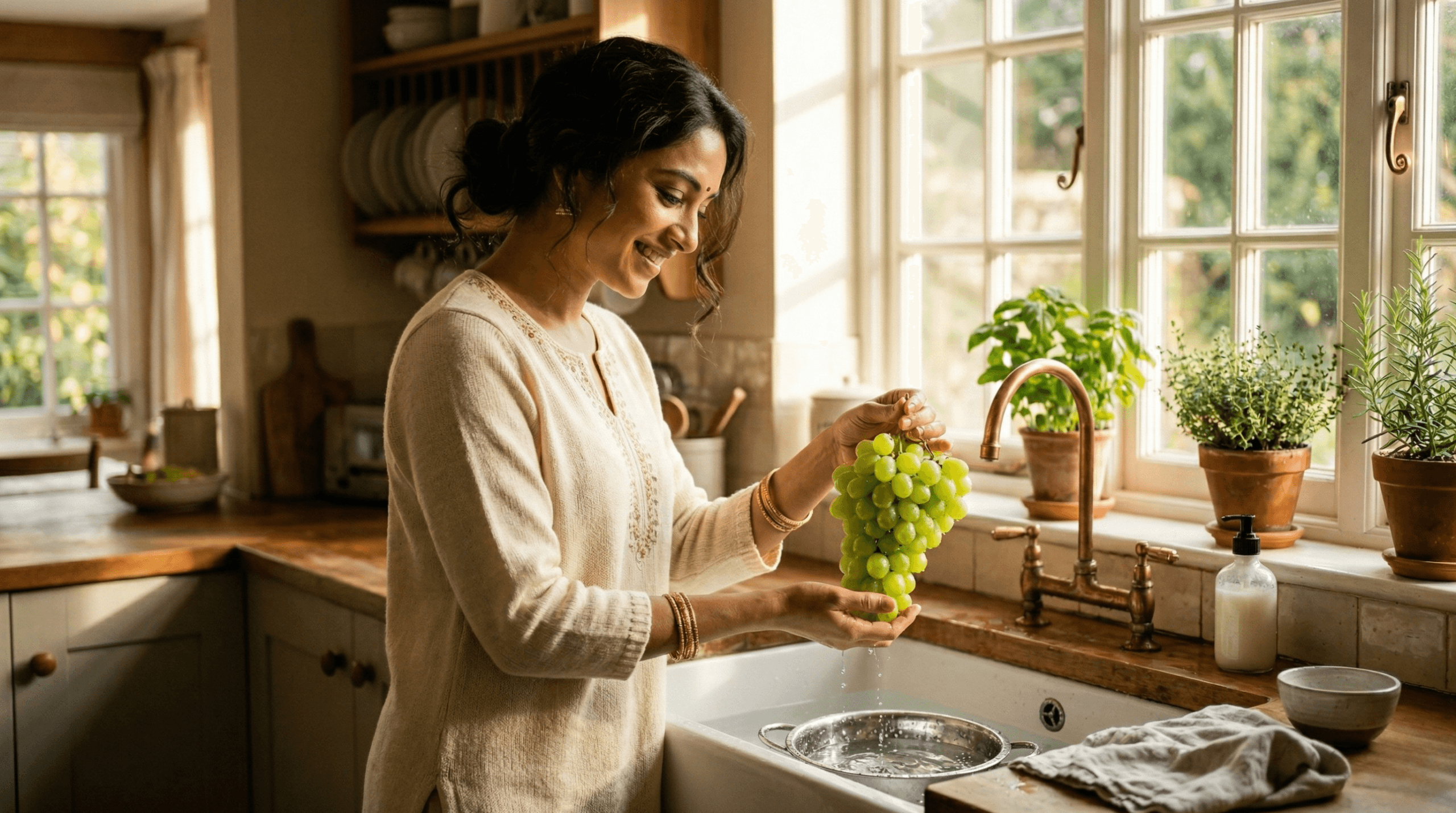
Wondering how to clean grapes properly? Stop eating pesticide dust. I share the exact chemistry-backed method to strip the bloom and nasty residue fast.
The chalky film coated my tongue like crushed aspirin. I spat the half-chewed Thompson Seedless into a cheap paper napkin right there on a dusty street corner in Nashik, Maharashtra. I had just purchased a gorgeous, frosty-looking bunch from a roadside vendor near the sprawling local vineyards.
But that white “frost” wasn’t just natural yeast. It was a rancid cocktail of agricultural dust, exhaust fumes, and commercial fungicide.
If you want to avoid that bitter, tongue-numbing sensation, you need to know how to clean grapes properly. Because a quick, lazy rinse under the kitchen tap does absolutely nothing.
Nothing at all.
You end up swallowing a microscopic chemical soup. And the resulting stomach ache is never worth the snack.
The Disgusting Reality of the Supermarket Produce Aisle
Let’s talk about that whitish haze coating your fruit. Farmers casually refer to it as the “bloom.”
Biologically, it acts as a natural moisture barrier. It defends the delicate skin against premature rot and aggressive insects.
And it is insanely sticky.
Water simply beads right off it. When you run cold municipal tap flow over a cluster of Autumn Crisp berries, you are just giving the agricultural residue a gentle, useless bath. The toxic compounds cling desperately to that waxy bloom.
To strip it away completely, we need mild friction and a specific chemical reaction. Not a harsh dish detergent.
Never use Dawn soap. You will end up tasting artificial lemon bubbles for a week.
People constantly ask me how to clean grapes properly without ruining the crisp texture. The answer lies in basic pantry chemistry, not expensive organic vegetable washes sold in plastic spray bottles.
Those commercial sprays are mostly just overpriced water and weak citric acid. A complete waste of your cash.
The Real Science Behind How to Clean Grapes Properly
Understanding how to clean grapes properly means you have to respect the physical anatomy of the cluster. Look closely at the stem structure.
The main stalk is called the rachis. The tiny, fragile stems attaching directly to the fruit are the pedicels.
The junction where the pedicel meets the fruit is a microscopic garbage dump. Dirt, spider mites, and chemical sprays accumulate in that tiny crevice during the entire growing season.
A passive rinse ignores this crevice entirely. You have to force the contaminants out.
Read our ultimate guide to extending the shelf life of fresh grocery store produce
This requires submerging the entire bunch in a reactive solution. We want to break the molecular bonds of the waxes holding the dirt against the skin.
You might assume buying organic varieties solves this entire mess. You are entirely wrong.
Organic farmers still rely on heavy-duty defensive sprays. Copper sulfate is a widely approved organic fungicide used to fight mildew in wet climates.
And it tastes violently like rusted pennies.
You must figure out how to clean grapes properly before serving them to anyone, regardless of the flashy organic sticker on the plastic clamshell. The label does not protect your gut microbiome.
The Arm & Hammer Alkaline Protocol
The most fiercely effective tool for this job sits in the back of your baking cabinet. Sodium bicarbonate.
Arm & Hammer baking soda is highly alkaline. When dissolved in lukewarm liquid, it creates an environment that rapidly shreds acidic pesticide residues.
Chemicals like phosmet and captan degrade aggressively when exposed to an alkaline bath. This is a documented, scientific reality.
So, mastering how to clean grapes properly requires a generous scoop of baking soda.
Fill a heavy Pyrex glass bowl with lukewarm water. Do not use freezing cold water.
Cold water forces the natural wax to contract and harden like armor. Lukewarm water gently softens the barrier without cooking the fruit into a mushy disaster.
Dump in two heaping tablespoons of baking soda. Agitate the water with your bare hands until the powder vanishes entirely.
Submerge the clusters fully. Let them drown for exactly twelve minutes.
Twelve minutes. No less.
During this soaking phase, the alkaline solution breaks down the oily fungicides. The sheer amount of dirt that separates from the fruit is horrifying.
The water will slowly turn into a murky, gray sludge. It looks exactly like dirty mop water.
Pouring that gray liquid down the drain feels like dodging a severe medical bullet. It validates the entire annoying process.
How to Clean Grapes Properly When Dealing With Heavy Fungicides
Sometimes, the baking soda bath is simply not aggressive enough. If you buy imported varieties heavily treated for long international transit, you need a stronger abrasive.
This is where the Salt Scrub technique becomes necessary.
Pull the soaked clusters out of the alkaline bath. While they are still dripping wet, sprinkle them generously with Diamond Crystal Kosher Salt.
Kosher salt features large, jagged flakes. These flakes act like tiny shards of soft glass.
Gently massage the salt directly onto the skins with your fingertips. The friction physically scrapes away the stubborn, weakened wax layer.
Do not crush the fruit. Roll them lightly between your palms.
The salt immediately dissolves any remaining sticky patches. Your fingers will physically feel the texture shift from slippery and waxy to squeaky and pristine.
This step is critical for thick-skinned varieties like Concord or Moon Drops. Their rugged exteriors can handle the mechanical scrubbing without tearing.
Thin-skinned Cotton Candy grapes require a much lighter touch. Heavy friction will rupture their tight skins and invite immediate bacterial rot.
The Heinz Vinegar Delusion
Many eager home cooks swear by acetic acid. They dump a cup of Heinz White Vinegar over their fruit and assume the job is done.
Vinegar is exceptional at killing surface-level bacteria. It attacks the cellular walls of common pathogens effectively.
But it does absolutely nothing to oil-based agricultural waxes.
Pesticides are intentionally formulated with heavy oils so they survive violent rainstorms in the fields. Acetic acid simply bounces off these oily barriers.
If you truly want to know how to clean grapes properly, you must use vinegar strictly as a secondary sanitation step, never as the primary degreaser.
After the baking soda purge, rinse the fruit thoroughly. Then, submerge them in a brief bath of one part vinegar to three parts water.
Let them sit for just two minutes. This kills any lingering bacteria hiding near the pedicel junctions.
Rinse them one final time under a heavy, pressurized stream of cold water. The cold shock snaps the skins tight again, restoring that vital, satisfying crunch.
The Hidden Dangers of Poor Storage
The debate over how to clean grapes properly usually ends at the sink. That is a massive mistake.
Knowing how to clean grapes properly extends their shelf life, but only if you dry them correctly. Moisture is the ultimate enemy of preserved fruit.
A wet cluster sitting in a sealed plastic bag will sprout aggressive, gray mold spores within twenty-four hours. It is a rapid, foul decay.
You must strip the moisture away immediately.
I rely heavily on my OXO Good Grips salad spinner for this task. It is the most efficient water-extraction tool in the kitchen.
Line the basket of the spinner with a thick, clean flour sack towel. Place the dripping clusters gently inside.
Spin them slowly. Do not crank the handle like you are starting a lawnmower, or you will bruise the delicate flesh.
The centrifugal force rips the hidden water droplets out from deep inside the central stems. The towel catches the moisture, protecting the fruit from bouncing against the hard plastic walls.
If you do not own a spinner, lay them out flat on a wire baking rack. Aim a small tabletop fan directly at them for twenty minutes.
Airflow is your best friend here.
Navigating the Refrigerator Rules
Once completely bone-dry, storage becomes the final hurdle. Never put them back into the original, soiled plastic clamshell.
That container is still coated in invisible chemical dust. You would just be recontaminating your pristine fruit.
Transfer the dry clusters to a clean, ventilated glass container. Leave the lid slightly cracked to allow ethylene gas to escape.
Ethylene is a natural ripening hormone. If it gets trapped in a sealed jar, the fruit will prematurely age, turning brown and shriveled.
Keep them in the coldest, back corner of your refrigerator drawer. Away from strong-smelling foods like raw onions or garlic.
The skins are highly porous. They will rapidly absorb the scent of yesterday’s leftover takeout if you aren’t careful.
Eating a handful of Autumn Crisps that vaguely taste like minced garlic is a deeply upsetting experience.
Why We Endure the Hassle
People often complain that this entire routine is tedious. They ask why researching exactly how to clean grapes properly is worth the lost time.
The answer is buried in the regulatory data.
The <a href=”https://www.google.com/search?q=https://www.epa.gov/safepestcontrol/pesticides-and-food” target=”_blank” rel=”noopener”>EPA guidelines on agricultural residues</a> dictate what is legally permissible to leave on the crops before sale. “Permissible” does not mean healthy or safe for daily consumption.
Chlorpyrifos and other neurotoxic insecticides have been heavily restricted, yet traces continually show up in domestic supply chains.
You are the final line of defense for your own body.
Once you learn how to clean grapes properly, you never look at the produce aisle the same way again. The glossy shine on the fruit stops looking appetizing.
It starts looking like a threat.
The crunch of a perfectly purged, squeaky-clean berry is a revelation. The flavors are sharper, sweeter, and entirely devoid of that bitter, chemical aftertaste.
You actually taste the natural sugars, not the protective spray from a distant packing plant.
Next time you reach into the fridge for a quick, unwashed snack, pause for a second. Think about the murky, gray sludge pooling at the bottom of that glass bowl.
Are you really willing to blindly chew on that?