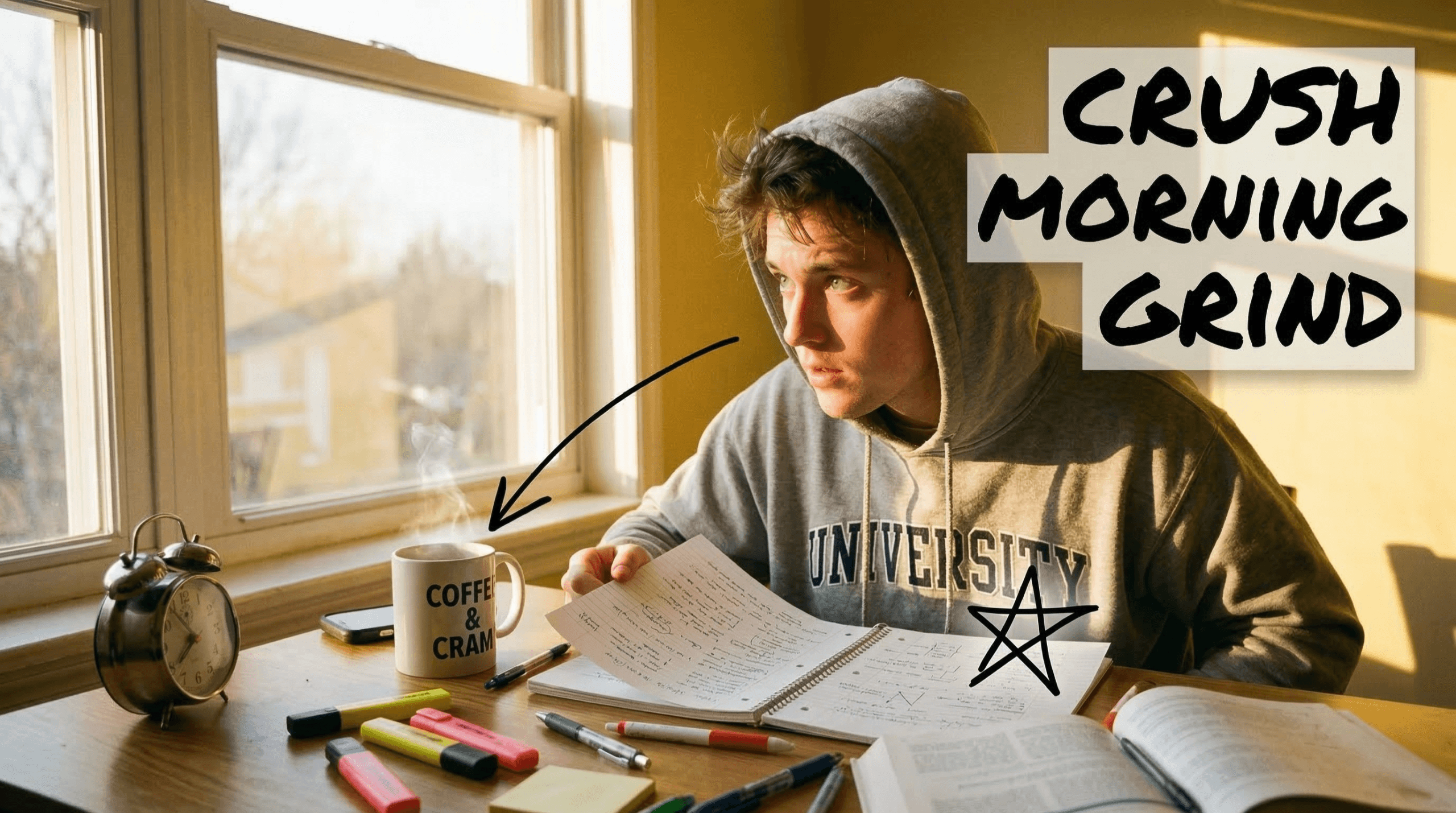
A morning routine for students dictates your entire semester’s success. Grab these weird, science-backed habits to crush exams without the burnout.
My alarm blared at 7:43 AM in a freezing Ann Arbor apartment. The floorboards were ice-slicked. My brain felt like it was wrapped in wet, heavy gauze.
I had a brutal Organic Chemistry midterm starting in exactly forty-seven minutes, and I was already suffocating under the weight of my own academic failures. The wind howling off Lake Huron rattled the single-pane window, mocking my exhaustion.
And that was the exact moment I realized my current habits were actively sabotaging my degree. Crafting a morning routine for students is rarely about aesthetic Instagram reels or sipping matcha in a sun-drenched loft.
It is about survival. Raw, unadulterated survival. You are fighting a biological war against sleep inertia, cortisol spikes, and the crushing anxiety of looming deadlines.
So. Where do we begin the reconstruction?
The Biological Anchor of a Morning Routine for Students
You are fighting a biochemical battle the second you peel your eyelids apart. Melatonin is still clinging stubbornly to your neural receptors. Your cortisol is staggering around like a punch-drunk boxer looking for a fight.
Most undergrads reach blindly for their cracked iPhone screens immediately upon waking. This is cognitive suicide. The sudden flood of blue light and digital dopamine completely shatters your natural waking rhythms.
Instead, you need a physical mechanism to forcefully eject that lingering sleep inertia from your skull. Something tactile. Something real.
Anatomy of a Morning Routine for Students That Actually Works
Andrew Huberman constantly preaches the gospel of morning sunlight. But in Michigan during late February? The sun is a myth.
This is where you must rely on targeted environmental design. I bought a Philips SmartSleep Wake-Up Light to artificially simulate a sunrise next to my pillow. It gradually floods the room with lux-heavy lumens.
Because your brain requires actual photons, not caffeine, to properly boot up the prefrontal cortex. This artificial dawn triggers your Cortisol Awakening Response naturally, preventing that heavy, dragging sensation.
Step 1: The Saline Shock System
Let us examine the biological desert currently sitting in your stomach. You just exhaled moisture and sweat into your sheets for eight hours straight.
Your cellular structure is begging for raw hydration. Chugging black coffee right away is like pouring battery acid onto a shriveled, dying houseplant.
I keep a liter of cold water laced with a single packet of LMNT raw unflavored electrolytes on my nightstand. The sharp hit of sodium fires up your neural pathways before you even swing your legs out of bed.
Every successful morning routine for students requires this sudden saline shock. Without it, you are simply running your body on borrowed, anxious adrenaline.
Step 2: The Zeigarnik Brain Dump
Your brain functions terribly as an office filing cabinet. It holds onto open tasks obsessively, creating an ambient, buzzing hum of anxiety.
Psychologists refer to this maddening phenomenon as the Zeigarnik effect. You can learn more about how incomplete tasks haunt our working memory in this comprehensive study from the American Psychological Association.
We fix this cognitive leak with a Moleskine classic notebook and a single uniball Vision Elite pen. Not a productivity app. Not a digital calendar.
Write down the three ugliest, most terrifying assignments you have due today. Just stare at them on the paper. Externalizing the threat drastically reduces your amygdala’s panic response.
Step 3: Imposing Kinetic Friction
You absolutely do not need to run a grueling half-marathon before your 9 AM lecture. That is pure masochism masquerading as discipline.
But you do need aggressive kinetic movement to flush the stagnant lymphatic sludge out of your heavy muscles. I keep a 16-kilogram cast-iron kettlebell right next to my closet door.
Fifty brutal Russian swings. It takes exactly three minutes of gasping effort.
Your heart rate spikes violently, fresh blood rushes to the cerebral cortex, and suddenly, that impending essay doesn’t look quite so monstrous. A harsh truth. Your body demands movement to banish the fog.
The Chemistry of a Calibrated Morning Routine for Students
Adenosine is a tricky little chemical that slowly builds up in your brain, signaling your body that it is time to sleep. Caffeine operates by temporarily blocking these specific receptors.
If you down a double espresso at 7:00 AM, the caffeine inevitably wears off by noon. Then, the pent-up adenosine crashes down on your nervous system like a falling piano.
Wait exactly ninety minutes after waking up to consume any caffeine. Let your body naturally clear out the chemical backlog first.
This single, irritating adjustment single-handedly saved my grades during my junior year. No more pathetic 2 PM library faceplants onto my textbook.
Step 4: Caloric Geography and Spikes
Fasting versus eating breakfast is a completely exhausted debate. The real, underlying issue is glycemic volatility.
Eating a massive bowl of sugary dining hall cereal guarantees an immediate, violent blood glucose spike. This is rapidly followed by a brutal crash right when your professor starts handing out the complex syllabus.
Keep your morning fuel brutally, predictably simple. Three scrambled eggs cooked heavily in Kerrygold butter.
Fat and protein provide a slow, agonizingly consistent burn of kinetic energy. Your heavily taxed pancreas will thank you later.
Step 5: The Power of Absolute Refusal
Your smartphone is a highly sophisticated slot machine designed by billionaires to harvest your raw attention. Do not let them win before you have even eaten breakfast.
Keep the device locked tightly on Airplane mode until you physically step out your front door. The world will not spontaneously combust just because you ignored a noisy group chat for forty-five minutes.
This hard boundary establishes immediate psychological dominance over your chaotic day. You act. You strictly refuse to react.
Step 6: Stacking the Behavioral Deck
Habit stacking serves as the ultimate duct tape of modern behavioral psychology. You deliberately anchor a brand new, fragile habit to a rock-solid old one.
The moment I finish brushing my teeth with Crest Pro-Health toothpaste, I immediately drop to the bathroom floor for twenty pushups.
No internal debate. No whining hesitation. The plastic toothbrush clicking back into the cup is the unavoidable physical trigger.
Constructing a durable morning routine for students requires actively removing the friction of choice. Decision fatigue remains your greatest hidden enemy.
Step 7: Defensive Environmental Architecture
Willpower is a strictly finite mental resource. Relying on it constantly is a fool’s errand.
Set your thick winter clothes out the night before. Put your apartment keys directly inside your heaviest boots. Stage your packed backpack right against the front door.
If your morning routine for students forces you to make complex choices, it will inevitably collapse. Make the correct actions physically unavoidable.
You want the path of least resistance to pull you straight toward a productive day. We call this designing a fail-safe environment.
Advanced Tactics for a Hostile Morning Routine for Students
The freezing walk across campus is never just empty, wasted time. It functions as a crucial psychological airlock between your bed and the lecture hall.
Instead of blasting aggressive heavy metal, listen to a highly complex, demanding podcast. I typically play episodes of the Lex Fridman Podcast focusing on artificial intelligence or deep history.
Prime your auditory processing centers for the dense academic language you are about to endure. Warm up the mental engine slowly before you aggressively throw it into gear.
Dealing with Catastrophic System Failure
Some mornings, absolutely everything shatters into pieces. You sleep right through the Casio alarm. The power grid fails.
You desperately need a contingency plan. A tightly compressed, five-minute emergency version of your ideal sequence.
Chug the salty water. Grab a chalky protein bar. Sprint wildly to catch the campus bus.
An effective morning routine for students is never a fragile, delicate glass sculpture. It must function as a heavy-duty shock absorber for unexpected chaos.
Ruthlessly Analyzing the Biological Data
You must learn to ruthlessly audit your own daily biology. If you find yourself completely exhausted at 11 AM, something in your system is deeply broken.
Keep a brutal, honest ledger of your daily energy levels. The National Sleep Foundation offers incredible resources on tracking your sleep architecture and identifying hidden energy leaks.
Did that greasy, late-night pizza actively destroy your deep REM sleep? Did the massive afternoon cold brew linger far too long in your bloodstream?
Adjust the microscopic dials. Test the moving variables. Treat your own body like a chemistry experiment.
The Dangerous Illusion of Perfection
Stop trying desperately to mimic eccentric billionaires who employ private chefs and have zero 8 AM calculus classes. Your current reality is drastically different.
Your cramped dorm room is incredibly loud. Your roommate operates on a chaotic, unpredictable schedule.
Your morning routine for students must be tough enough to survive inside a highly hostile environment. Adaptability remains your single greatest asset in college.
When the routine breaks, you simply patch it with duct tape and keep moving forward.
The Hidden Prerequisite
We almost always ignore the night before, but it quietly dictates absolutely everything. The war for your morning is won in the dark.
Shut down the glowing screens at least an hour before sleep. Drop the ambient temperature in your room to a freezing sixty-five degrees.
Read a physical, battered paperback book. Fiction works best. Disconnect completely from the harsh, biting reality of grades, essays, and crushing tuition debt.
Because tomorrow morning, the sun is going to rise. The alarm is going to scream.
But if you can’t even manage to conquer the very first hour of your own day, what makes you think you can conquer the rest of your life?