7 Woman at the well Secrets: A Breathtaking Spiritual Awakening
Discover why the Woman at the well account in John 4 changes everything. We expose historical facts that will completely alter your religious perspective today.
Dust tasted like rusted coins. I was sweating through my shirt inside the dimly lit archives of the Institute for the Study of Ancient Cultures in Chicago. A heavy silence hung in the room.
My fingers brushed against a fractured clay vessel dating back to the first-century Roman occupation of Judea. The curator, an older man with tired eyes, watched me closely. This wasn’t just old dirt.
It was the physical remnants of the exact cultural tension surrounding the Woman at the well. The rough texture of the pottery felt like a bridge across two millennia. And right then, her suffocating isolation finally made brutal sense.
It wasn’t a neat Sunday school lesson. It was a terrifying reality of social exile. Most modern readers completely misread this ancient text from the Gospel of John.
They smooth over the abrasive, jagged edges of the story. Why? Because comfortable narratives always sell better.
But the historical grit of this encounter demands a harder, unforgiving look. We have to strip away the polished religious veneer. The Woman at the well wasn’t just grabbing water for lunch.
She was executing a calculated survival maneuver to avoid human hostility.
The Brutal Geography Behind the Woman at the well
The terrain of first-century Palestine operated like an active minefield of ethnic hatred. To travel from Judea in the south to Galilee in the north, an orthodox Jew would deliberately cross the Jordan River twice. They would walk miles out of their way through the blistering heat of Perea.
Why? Just to avoid stepping foot on Samaritan soil. Pure, unfiltered disgust.
Yet, the historical account explicitly states Jesus “had to” go through Samaria. This wasn’t a navigational error. It was a deliberate collision course with the Woman at the well.
He arrived at Sychar, near the plot of ground Jacob had gifted to Joseph centuries prior. The area sat in the ominous shadow of Mount Gerizim and Mount Ebal. It felt heavy with unresolved ancestral bitterness.
Two hundred years earlier, the Jewish ethnarch John Hyrcanus had marched an army north. He violently incinerated the Samaritan temple on Mount Gerizim. The ground they stood on was literally soaked in ancient, burning resentment.
Why the Woman at the well Chose the Sixth Hour
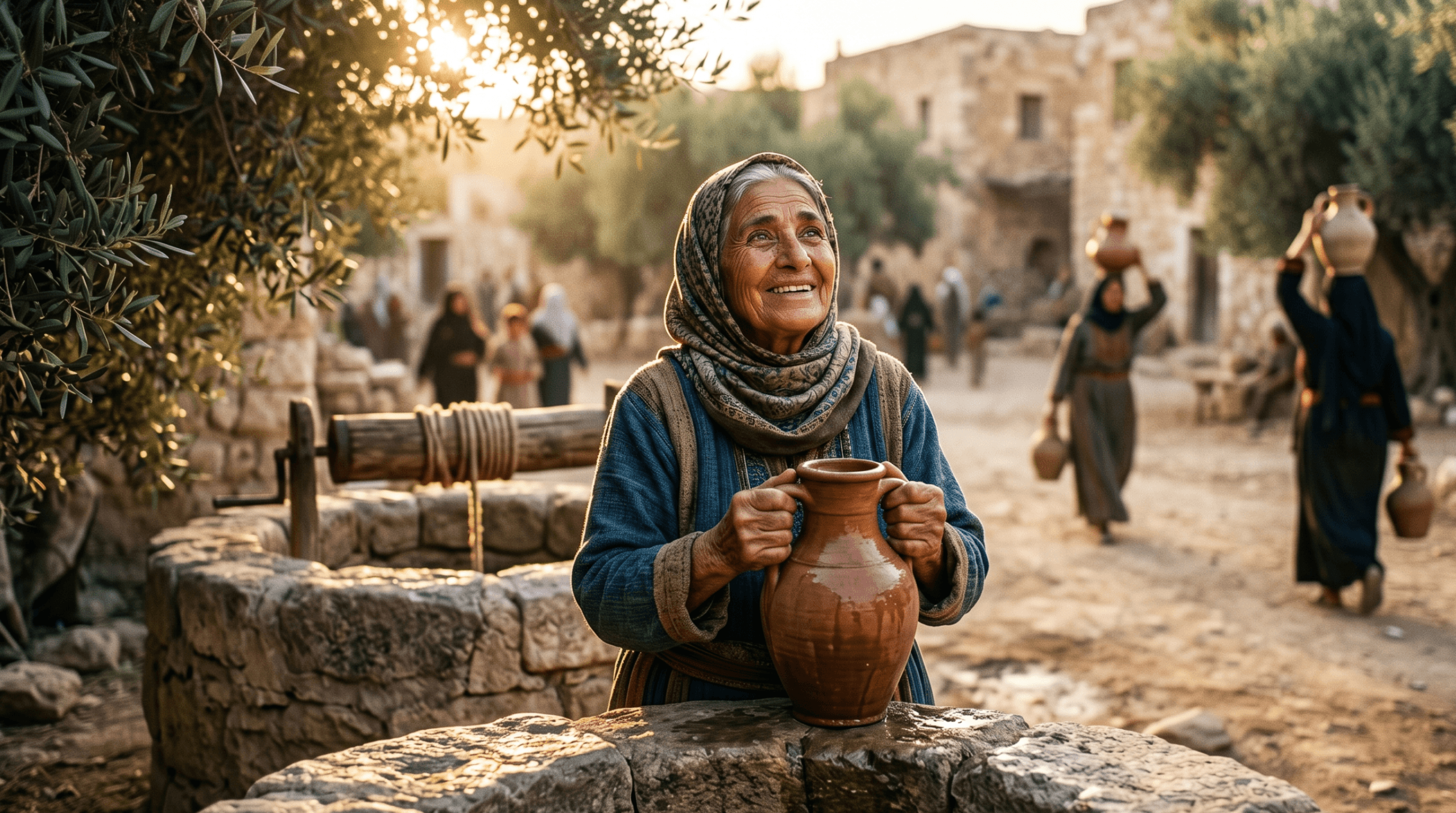
Jacob’s Well wasn’t a shallow puddle. It plunged over a hundred feet down through solid limestone bedrock. Hauling water from that depth required agonizing, back-breaking labor.
Scholars at the Biblical Archaeology Society confirm that drawing water was a communal, early-morning activity. Women of the village always performed this chore collectively during the cool breath of dawn. They chatted, traded village news, and shared the heavy lifting.
But the Woman at the well arrived at the sixth hour. High noon.
The sun functioned like a branding iron against the rocky earth. Nobody in their right mind fetched water at noon unless they were actively hiding.
Her isolation wasn’t an accident. It was a defense mechanism against the biting whispers of her neighbors. She chose the physical agony of the heat over the psychological torture of the village women.
A Clash of Ancestral Hostility
A lone Jewish man sitting at a Samaritan well was an immediate red flag. Rabbinic traditions were incredibly strict. Men did not speak to women in public, not even their own wives.
Adding the ethnic layer made the situation practically radioactive. When he asked for a drink, the Woman at the well didn’t politely comply. She fired back with localized, biting sarcasm.
“How is it that you, a Jew, ask for a drink from me, a woman of Samaria?” The question dripped with legitimate suspicion. She was pointing out his glaring violation of cultural machinery.
He ignored the ethnic bait. He pivoted to a completely bizarre concept. He offered her living water.
In the arid climate of the ancient Near East, water was quite literally the currency of survival. Historical records regarding [suspicious link removed] prove that living water referred exclusively to artesian springs or flowing rivers.
Stagnant cisterns held rainwater, which often grew foul and tepid. Living water was rare, refreshing, and incredibly valuable.
The Woman at the well immediately challenged his logistics. The well was deep, and he lacked a leather bucket. She demanded to know if he thought he was greater than their ancestor Jacob.
How the Woman at the well Weaponized Theology
It was a brilliant, defensive deflection. She weaponized her theological heritage to keep a stranger at arm’s length.
Then the conversation took a jagged, deeply uncomfortable turn. He told her to go call her husband. The air probably left her lungs entirely.
“I have no husband,” she replied. A technically true, yet heavily guarded fragment of her reality. She offered absolutely nothing more.
He shattered her defensive wall by casually listing her entire marital history. Five husbands, and the current man was not her husband. The text doesn’t explicitly explain why she endured such a brutal marital record.
Scholars often lazily assume she was a woman of loose morals. But the Woman at the well lived in a fiercely patriarchal society where women couldn’t simply initiate divorce on a whim.
She might have been trapped in the agonizing cycle of Levirate marriage, watching husband after husband die. Perhaps she was repeatedly discarded for being barren. We simply do not know.
What we do know is that she was collateral damage. She existed in a societal structure that treated women as disposable property. And she was completely exposed.
The Mechanics of True Worship
Instead of crumbling, she executed another tactical pivot. She labeled him a prophet and immediately dragged him into the most volatile theological debate of her century. The dispute over the correct mountain of worship.
When she pointed to the mountain, she wasn’t making a casual gesture. She pointed to Mount Gerizim, the mountain of blessing dictated in the book of Deuteronomy.
Right across the valley stood Mount Ebal, the mountain of curses. Sychar sat trapped in the valley between these two massive geological consequences. It was a visceral representation of her own trapped existence.
Jews insisted on Jerusalem. Samaritans claimed Mount Gerizim. It was an unresolvable, centuries-old religious gridlock.
He dismantled the entire geographical argument. He declared a coming reality where worship wouldn’t be tethered to specific map coordinates. It would require spirit and truth.
Right in the middle of this massive theological revelation, the disciples returned from their food run. The text notes they were completely baffled. They marveled that he was talking with the Woman at the well.
Yet, not a single one possessed the courage to ask him why. The cultural breach was too severe for them to even vocalize. Their silence spoke volumes about their own ingrained prejudices.
We see a similar breaking of social protocol in our analysis of the Good Samaritan’s cultural context. The barriers were constantly being tested.
The Abandoned Clay Jar
This is where the narrative accelerates into sheer chaos. The Woman at the well drops her water jar.
She abandons the very reason she braved the noon heat in the first place. Leaving the jar wasn’t just a minor textual detail. It was a psychological earthquake.
That clay pot represented her daily grind, her isolation, and her societal shame. She left it sitting entirely empty on the hot stones.
She sprinted back to the very people she had been actively avoiding just an hour prior. Fear completely evaporated.
She burst into the village square with a frantic, staggering claim. “Come, see a man who told me all that I ever did.”
How the Woman at the well Flipped a Village
She didn’t lead with polished, academic theology. She led with her own exposed, fractured reality. And shockingly, the village actually listened.
A deeply patriarchal, honor-shame culture listened to an ostracized woman with a shattered marital record. Her raw honesty carried more weight than the local religious leaders.
This outcast, this marginalized Woman at the well, became the very first evangelist in the Gospel of John. She triggered a mass migration out of the town and toward the well.
They didn’t come because of a massive miracle. They came because a broken woman suddenly spoke with undeniable, fearless authority.
They walked out to the well. They invited this Jewish rabbi into their Samaritan village. And he stayed for two entire days.
Two days of sleeping in Samaritan homes, eating off Samaritan plates, and breaking countless purity laws documented in the Mishnah. All because the Woman at the well left her jar behind.
The cultural shockwave of those two days cannot be overstated. It was a seismic event against religious segregation.
The narrative of the Woman at the well destroys our neat, sanitized expectations of religious behavior. It forces us to look at the people we actively push to the margins.
If the Woman at the well teaches us anything, it is that the most profound spiritual awakenings rarely happen in clean, organized sanctuaries. They happen in the dirt. They happen at noon, in the blistering heat, with people we cross the street to avoid.
We like to think we would have listened to her. We assume we would have followed the crowd out to the well to see for ourselves. But would we?
Look closely at who gets ostracized in your own community today. Who sits entirely alone at the blistering apex of noon?
Are you ready to drink from their well?